طريقة أوضح للتوظيف
تجاوز حدود السيرة الذاتية.
تعرّف على المهارات.
حوّل وصفك الوظيفي إلى اختبار مهارات أو مقابلة بالذكاء الاصطناعي. احصل على تقارير واضحة عن المرشحين قبل مكالمتك الأولى.
لقادة الأعمال والمديرين وفرق الموارد البشرية ووكالات التوظيف وكل من يريد تقييم شخص للتعاون معه.
كيف تعمل المنصة
من الوصف الوظيفي إلى قائمة المرشحين المختصرة في خمس شاشات
لا حاجة إلى تثبيت أي شيء، ولا إلى إنشاء حساب للمرشحين.
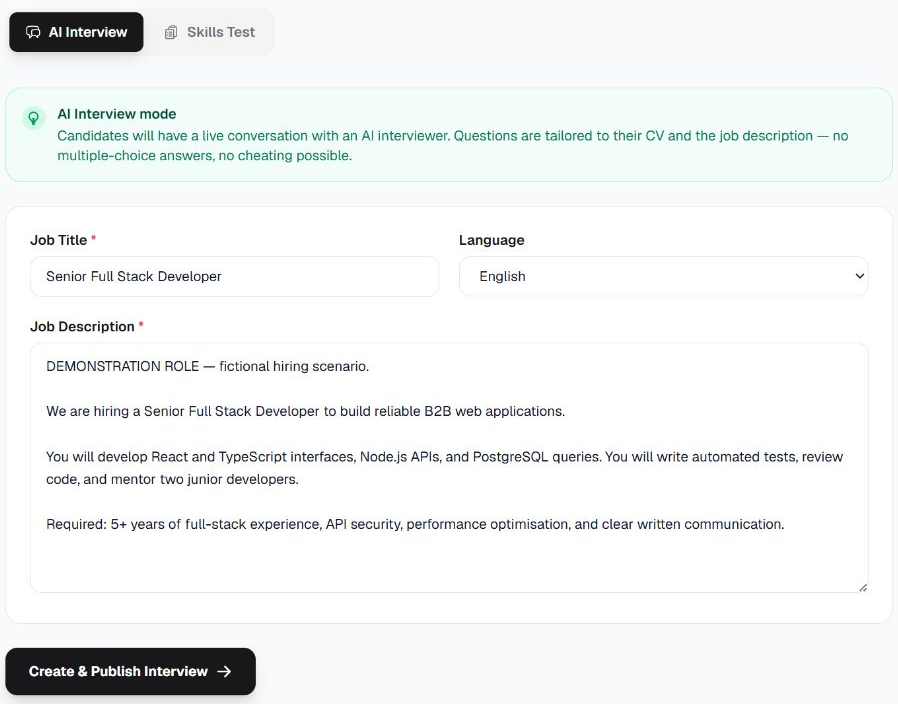
أنشئ تقييمًا مخصّصًا لمنصبك
أضف وصفك الوظيفي، واختر اختبار اختيار من متعدد أو مقابلة بالذكاء الاصطناعي، ثم حدّد اللغة.
- التقييم والتقارير بلغتك المختارة
- وضع الاختيار من متعدد: راجع الأسئلة وأعد توليدها
- الإنجليزية أو الفرنسية أو الإسبانية أو العربية الفصحى
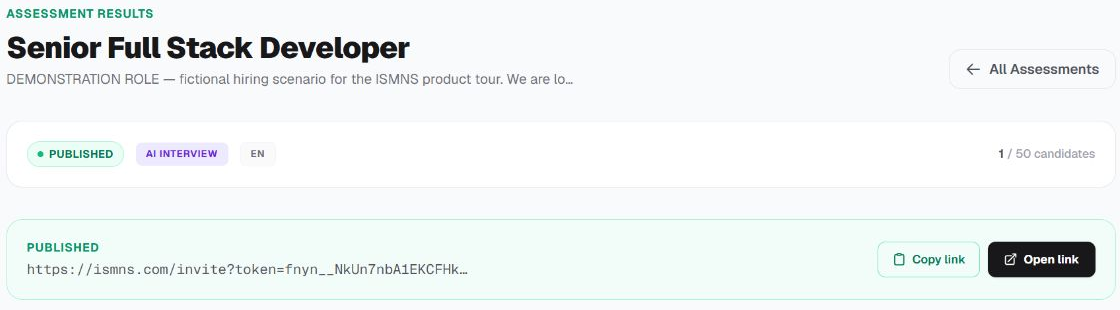
أرسل الرابط إلى المرشحين
شارك رابط التقييم. يفتحه المرشحون ويبدؤون دون إنشاء حساب.
- لا يحتاج المرشح إلى حساب
- يعمل على الهاتف
- رابط واحد لكل منصب
قيّم المهارات في سياق المنصب
يُجري المرشحون اختبار اختيار من متعدد مخصّصًا للمنصب أو مقابلة بالذكاء الاصطناعي تراعي وصفك الوظيفي وسيرتهم الذاتية وإجاباتهم.
- اختبار اختيار من متعدد محدّد الوقت بأسئلة عشوائية
- يتكيّف الذكاء الاصطناعي بأسئلته مع إجابات المرشح
- حفظ السيرة الذاتية ومحادثة المقابلة
AI Interview
Recorded demo · 21 messages
- AI interviewer:
Hello Alex, thank you for joining the interview today. Let's dive right into our first topic. Can you describe a specific situation where you optimized a PostgreSQL query for performance? What was the issue, and how did you resolve it?
- Candidate:
In the fictional Demo Studio project, a tenant dashboard endpoint had a p95 latency of about 900 ms. I used query logs and EXPLAIN (ANALYZE, BUFFERS) on representative data to find an N+1 query pattern and repeated scans when filtering by tenant and date. I replaced per-row lookups with a single scoped query and added a composite index matching the filter and sort order. I checked tenant isolation and compared results before and after the change. In our synthetic example, p95 fell to 280 ms under the same workload. I also monitored write overhead and retained a rollback plan.
- AI interviewer:
Thanks for sharing that example, Alex. Let's move on to the next topic. Can you explain how you ensure API security when developing Node.js applications?
- Candidate:
I separate authentication from authorization. Each endpoint checks the authenticated user, their role and the tenant that owns the requested resource; a client-supplied tenant ID is never trusted on its own. I validate request schemas, use parameterized SQL and return only necessary fields. Secrets stay outside source code, tokens have short lifetimes, and cookies use secure settings where applicable. I add rate limits and safe error handling, and redact secrets from logs. In the demo project, integration tests include cross-tenant access attempts, expired sessions and malformed input. Dependency updates and security review are part of CI and release planning.
- AI interviewer:
Great, that provides a clear picture of your approach to API security. Now, let's discuss your experience with React and TypeScript. Could you describe a challenging feature you implemented using these technologies and the steps you took to overcome any difficulties?
- Candidate:
In the demo dashboard, I built a searchable table whose filters were shared with the URL. The difficult part was keeping fast typing, server requests and browser back navigation consistent. I used a typed filter model and runtime validation for URL values, kept draft input local, and debounced requests. I cancelled obsolete requests and ignored stale responses. I added keyboard navigation, explicit loading and empty states, and tests for back navigation and out-of-order responses. I chose simple components over a large state library because the state was confined to one feature.
- AI interviewer:
Thank you for that detailed explanation. Moving on, can you describe your approach to writing automated tests? How do you ensure they are effective and maintainable over time?
- Candidate:
I start from risks and observable behaviour. Unit tests cover deterministic business rules; integration tests exercise APIs with a real test database; a small set of Playwright journeys covers sign-in, tenant boundaries and critical workflows. I avoid coupling tests to component internals and use stable fixtures with explicit setup. When fixing a bug I add a regression case that fails for the original reason. CI runs fast checks on each change and slower suites separately. I investigate flaky tests instead of repeatedly rerunning them, and remove redundant tests when they no longer protect a meaningful behaviour.
- AI interviewer:
That's a solid approach to automated testing. Let's shift gears a bit. Could you tell me about a time when you had to mentor a junior developer? What strategies did you use to help them grow?
- Candidate:
In the fictional team, a junior developer struggled to diagnose intermittent API failures. We agreed on a small learning goal: turn an unclear bug report into a reproducible test. During pairing, I asked them to explain their hypothesis, inspect logs and narrow the input rather than taking over. We then wrote the regression test and a short debugging note together. In later reviews I separated blocking issues from suggestions and explained the reason behind each comment. We reduced pairing gradually as they became independent. I would assess progress through the problems they could solve and the questions they asked, not the number of lines written.
- AI interviewer:
Thank you for sharing that experience. Let's talk about performance optimization. Can you give an example of how you've improved the performance of a Node.js application? What specific techniques did you use?
- Candidate:
For a fictional CSV export feature, synchronous parsing and serialization caused event-loop delays that affected other requests. I measured event-loop lag, CPU usage and endpoint latency before changing the code. I moved long exports to a bounded background queue, streamed the output and applied backpressure instead of holding the whole dataset in memory. The API returned a job reference and the UI displayed progress. I capped concurrency to protect the database and tested failure recovery and duplicate requests. The trade-off was an asynchronous user flow, so we agreed on that behaviour with the product team. I would compare p95 latency, memory and error rates under the same load before claiming an improvement.
- AI interviewer:
That's a comprehensive approach to optimizing performance. Now, let's verify a specific claim from your CV. You mentioned working on integrating Jest tests and CI checks. Can you elaborate on how you set up these systems and how they benefited the development process?
- Candidate:
For the fictional Sample Works project, I configured Jest for fast TypeScript business-logic tests and a separate integration suite against an isolated PostgreSQL database. The CI pipeline installed locked dependencies, checked formatting and types, ran unit tests, then integration tests and a production build. Each test run used its own database state and secrets were injected by the CI environment. Pull requests could not merge if required checks failed. We added coverage for tenant boundaries and export retries after identifying risks, rather than chasing a coverage percentage. The benefit was earlier feedback and reproducible failures; I would track escaped regressions and flaky-test frequency to see whether it helped.
- AI interviewer:
Thank you for that detailed explanation. Now, let's explore a soft skill. How do you approach problem-solving when faced with a particularly challenging technical issue? Can you provide an example?
- Candidate:
I first describe the observed behaviour, impact and constraints, then list a few testable hypotheses. I reproduce the issue with the smallest useful case and change one variable at a time. In the fictional dashboard, users sometimes saw old search results after typing quickly. I used network timings to show that responses arrived out of order. I added request cancellation and a current-request guard, then a test that deliberately reversed response order. I shared a short explanation with the team and checked the fix with the designer. If evidence contradicts my hypothesis, I change direction; if I am stuck, I ask a colleague with a concise reproduction instead of hiding the delay.
- AI interviewer:
That's a thoughtful approach to problem-solving. Let's discuss collaboration. Can you share an example of how you've worked with a cross-functional team to deliver a project? What challenges did you face, and how did you overcome them?
- Candidate:
For the demo export feature, I worked with a designer, product manager and support colleague. The initial request was an instant download, but large datasets made that unreliable. I explained the constraint with measurements and proposed a background export with clear status and a retry option. We agreed on acceptance criteria for accessibility, completion time and failure messages, then released a small version behind a feature flag. Weekly demos exposed misunderstandings early. When scope grew, I made the delivery trade-offs explicit and let the product manager choose priorities. I documented the final decision and a rollback procedure for the team.
- AI interviewer:
Thank you for sharing that collaborative experience. Lastly, I'd like to discuss code reviews. How do you approach reviewing code from others to ensure quality and consistency?
- Candidate:
I first understand the intended behaviour and read the change in context. I check correctness, security boundaries, error handling, accessibility and meaningful tests before style. Automated formatting handles routine consistency so comments can focus on decisions. I label blocking issues and optional suggestions, explain the reason, and ask questions when I lack context. I keep reviews small and timely; for a complex design disagreement I propose a short discussion and record the outcome. In the demo team, a recurring checklist covered tenant isolation and database migrations. I also review my own assumptions and accept a simpler solution when it meets the requirements.
- AI interviewer:
Thank you, Alex, for all the detailed insights you've provided today. I appreciate you taking the time to discuss your experiences and skills with me. We'll be in touch soon regarding the next steps. Have a great day!
Fictional candidate · Preview only — no answers are sent
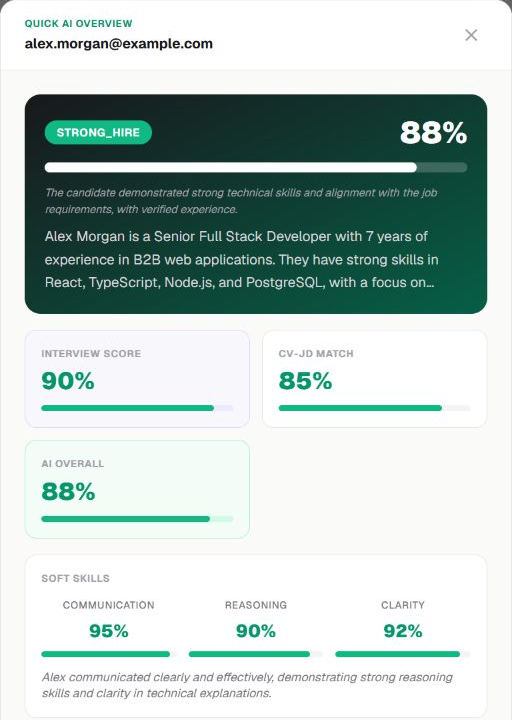
تعرّف على المرشحين الجديرين بمكالمة
يُقيَّم المرشحون ويُرتَّبون فور انتهائهم. افتح العرض السريع للاطلاع على التوصية والنتيجة والجوانب التي تحتاج إلى تطوير خلال ثوانٍ.
- ترتيب مباشر
- نقاط القوة والجوانب الناقصة وتوافق السيرة الذاتية
- مؤشر واضح للتوصية بالتوظيف أو عدمه
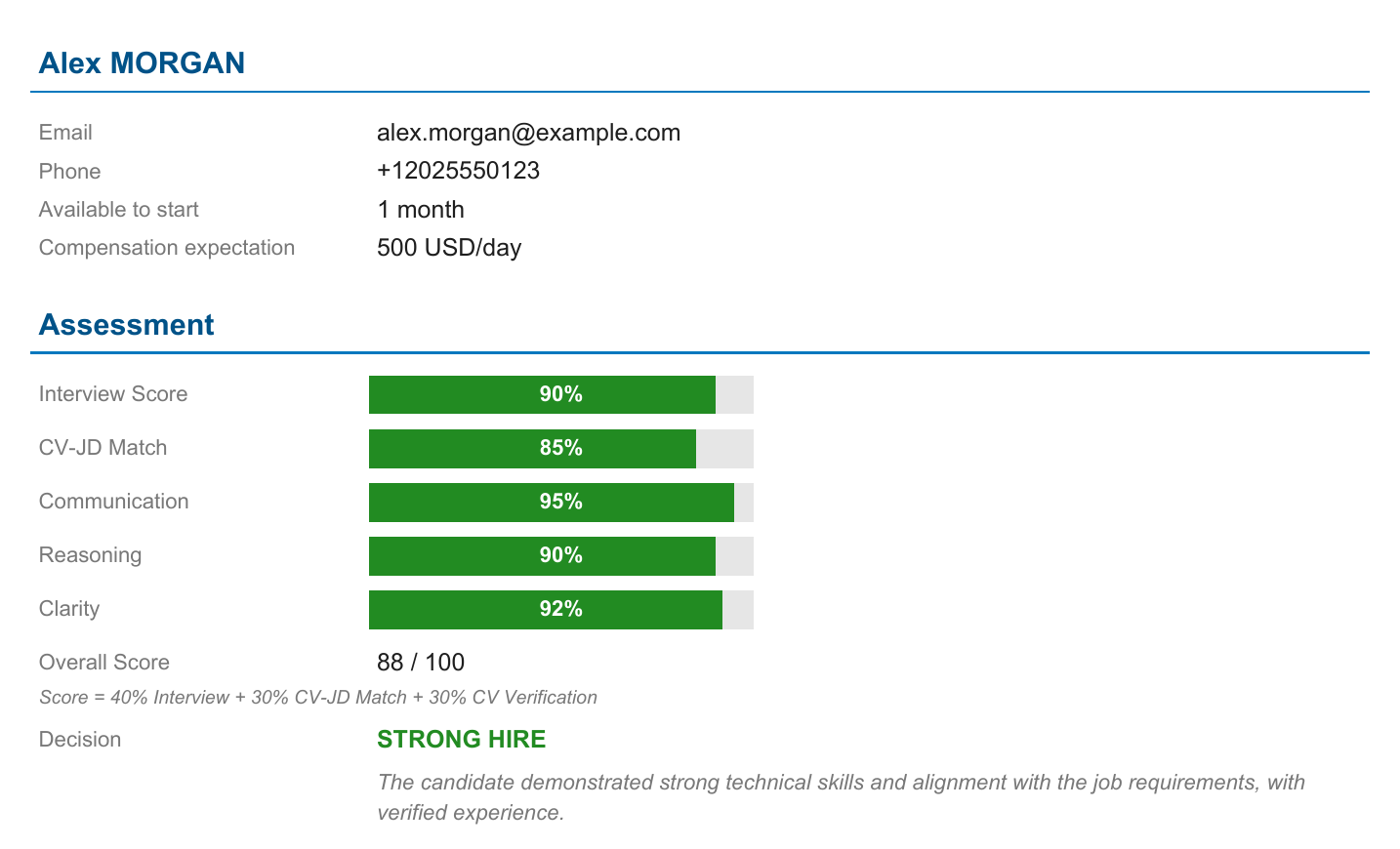
تواصل مع المرشحين الأكثر ملاءمة
راجع النتائج وتحليل السيرة الذاتية والجوانب التي تستحق التعمّق في تقرير واضح لتختار المرشحين الذين ستتواصل معهم.
- جاهز للمشاركة
- جاهز للأرشفة
- تنسيق موحّد لجميع المرشحين
لماذا تستحق التجربة
كل ما تحتاجه لاتخاذ قرار، قبل المكالمة الأولى.
يُنشأ كل تقييم خصيصًا لمنصبك، وليس من مكتبة اختبارات جاهزة. تتلقى عن كل مرشح معلومات عن مهاراته التي أثبتها، وتحليل سيرته الذاتية، وأجره المتوقع وموعد توفره. تختار من تتصل به وأنت تعرف هذه التفاصيل مسبقًا.
ابتداءً من $1.98 لكل مرشح. أقل من تكلفة مكالمة فرز أولية، وتدفع فقط مقابل المرشحين الذين تقيّمهم.
مهارات خضعت للاختبار
نتيجة لكل مهارة في إعلانك الوظيفي، مبنية على الاختبار لا على ما ورد في السيرة الذاتية فقط.
سيرة ذاتية محلّلة
مقارنتها بالمنصب: نقاط القوة والجوانب الناقصة والخبرات ذات الصلة.
الأجر وموعد التوفر
الراتب أو الأجر اليومي المتوقع وموعد بدء العمل، قبل التواصل مع المرشح.
التوافق والتوصية
مهارات شخصية ومؤشر للتوظيف أو عدمه وملف PDF واحد قابل للمشاركة.
نوعان من التقييم
اختبار مهارات أو مقابلة بالذكاء الاصطناعي: اختر حسب المنصب
اختبار للأعداد الكبيرة من المرشحين، ومحادثة للمناصب العليا والمناصب التي تتعامل مع العملاء.
اختبار المهارات
اختبار اختيار من متعدد محدّد الوقت، مُعدّ انطلاقًا من إعلانك الوظيفي. سريع في الإجابة والتصحيح، وصعب التحايل عليه.
- أسئلة مولّدة من الإعلان الوظيفي
- المراجعة وإعادة التوليد قبل النشر
- توقيت محدّد وأسئلة عشوائية ورصد الغش
- حد نجاح تلقائي
- نتيجة لكل مهارة
الأنسب لـ
المناصب التقنية والأعداد الكبيرة والفرز بمعايير موحّدة
مقابلة بالذكاء الاصطناعي
محادثة كتابية تتكيّف مع السيرة الذاتية للمرشح وإجاباته. تختبر معرفته وقدرته على شرحها.
- أسئلة مباشرة ومتكيّفة
- المهارات التقنية والشخصية
- تقييم الوضوح والاستدلال
- رصد تبديل النوافذ واللصق
الأنسب لـ
المناصب العليا والمناصب التي تتعامل مع العملاء وكل ما يتطلب مهارات تواصل
متردد؟ استخدم الاختبار للأعداد الكبيرة والمقابلة للمرشحين الثلاثة النهائيين. السعر نفسه في الحالتين.
الأسعار
أقل من تكلفة مكالمة فرز أولية، لكل مرشح.
باقة واحدة لكل منصب شاغر، ابتداءً من $9. دون اشتراك أو تراخيص لكل مستخدم أو مكتبة اختبارات جاهزة. استرداد خلال 7 أيام إذا لم يبدأ أي مرشح.
ابدأ بمرشح واحد
- ✓اختبار مهارات أو مقابلة بالذكاء الاصطناعي
- ✓تقييم مخصّص للوصف الوظيفي
- ✓تقرير PDF وتحليل السيرة الذاتية
مثالية لأول توظيف أو لقائمة مختصرة
- ✓اختبار مهارات أو مقابلة بالذكاء الاصطناعي
- ✓تقييم مخصّص للوصف الوظيفي
- ✓تقرير PDF وتحليل السيرة الذاتية
الأنسب لمنصب شاغر يستقطب عددًا كبيرًا من المرشحين
- ✓اختبار مهارات أو مقابلة بالذكاء الاصطناعي
- ✓تقييم مخصّص للوصف الوظيفي
- ✓تقرير PDF وتحليل السيرة الذاتية
حلول مخصّصة للتوظيف واسع النطاق
- ✓اختبار مهارات أو مقابلة بالذكاء الاصطناعي
- ✓تقييم مخصّص للوصف الوظيفي
- ✓تقرير PDF وتحليل السيرة الذاتية
تقييم واحد لكل باقة: اختبار مهارات أو مقابلة بالذكاء الاصطناعي. تشمل الباقة تحليل السيرة الذاتية وتقارير PDF. عرض تفاصيل الأسعار وسياسة الاسترداد
FAQ
الأسئلة الشائعة
ما الفرق بين اختبار المهارات والمقابلة بالذكاء الاصطناعي؟
اختبار المهارات هو اختبار اختيار من متعدد محدّد الوقت للمهارات التقنية. أما المقابلة بالذكاء الاصطناعي فهي محادثة كتابية تتكيّف مع سيرة المرشح وإجاباته وتقيّم مهاراته الشخصية أيضًا.
ماذا يتضمن تقرير PDF؟
نتائج حسب المهارة، وتحليل السيرة الذاتية، ونقاط القوة والجوانب الناقصة، وموعد بدء العمل والأجر وتوصية واضحة. وتضيف تقارير المقابلات نتائج التواصل والاستدلال والوضوح.
هل يمكنني تغيير الأسئلة؟
نعم. راجع كل سؤال قبل النشر وأعد توليد أي سؤال لا يناسبك.
ما اللغات المتاحة؟
الإنجليزية والفرنسية والإسبانية والعربية الفصحى. تُكتب الاختبارات والمقابلات مباشرة باللغة التي تختارها، ولا تُترجم من لغة أخرى.
هل يحتاج المرشحون إلى حساب؟
لا. يفتحون الرابط ويدخلون بريدهم الإلكتروني ثم يبدؤون، من أي جهاز.
هل بيانات المرشحين آمنة؟
تُشفَّر أثناء النقل والتخزين. ولا يمكن الاطلاع عليها إلا للمسؤول عن التوظيف الذي أنشأ التقييم.
كيف تعمل المقابلة بالذكاء الاصطناعي؟
تقرأ إعلانك الوظيفي والسيرة الذاتية للمرشح، ثم تُجري مقابلة كتابية مباشرة تتكيّف أسئلة المتابعة فيها مع كل إجابة.
كيف تُحدَّد الأسعار؟
باقة واحدة لكل منصب شاغر، ابتداءً من 9 دولارات أمريكية لمرشح واحد. دون اشتراك أو رسوم خفية. راجع صفحة الأسعار للاطلاع على سياسة الاسترداد.
ما الفرق بينها وبين مكتبات الاختبارات أو أدوات مقابلات الفيديو؟
لا مكتبة اختبارات عامة ولا ترخيص لكل مستخدم: يُنشأ التقييم خصيصًا لمنصبك خلال دقائق. المقابلة كتابية ومتكيّفة، فلا يحتاج المرشحون إلى تسجيل أنفسهم بالفيديو.
هل يمكنني البدء بمرشح واحد؟
نعم. تبلغ تكلفة باقة Single 9 دولارات أمريكية لمرشح واحد. أنشئ اختبار مهارات أو مقابلة بالذكاء الاصطناعي وراجع نتائج المرشح وتقرير PDF. لا يلزم اشتراك.
مقابلتك الأولى، مع المرشح المناسب.
ابدأ بمرشح واحد مقابل 9 دولارات أمريكية. ألصق وصفك الوظيفي وشارك رابط التقييم وراجع نتائج المرشح وتقريره.