Contrata con más claridad
Ve más allá del CV.
Evalúa las competencias.
Convierte tu descripción del puesto en una prueba de competencias o una entrevista con IA. Obtén informes claros antes de la primera llamada.
Para directivos, responsables de equipo, equipos de RR. HH. y agencias de selección.
3 candidatos gratis. Sin suscripción.
Cómo funciona
De la descripción del puesto a la preselección en cinco pasos
Sin instalaciones. Los candidatos no necesitan crear una cuenta.
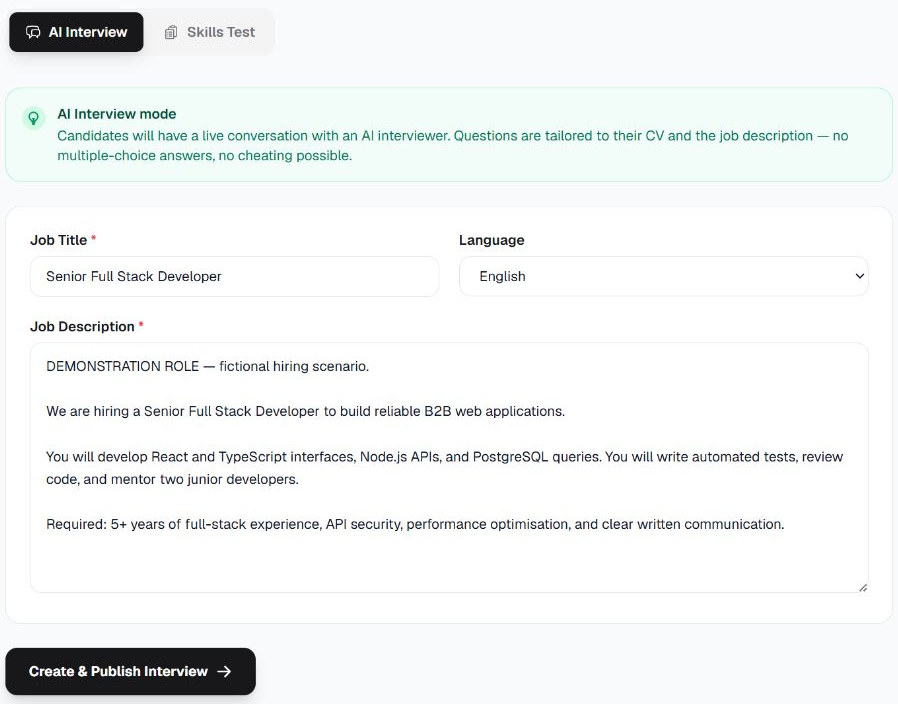
Crea una evaluación adaptada a tu puesto
Añade la descripción del puesto, elige una prueba de opción múltiple o una entrevista con IA y selecciona el idioma.
- Evaluación e informes en el idioma elegido
- Modo test: revisa y regenera las preguntas
- Inglés, francés o español
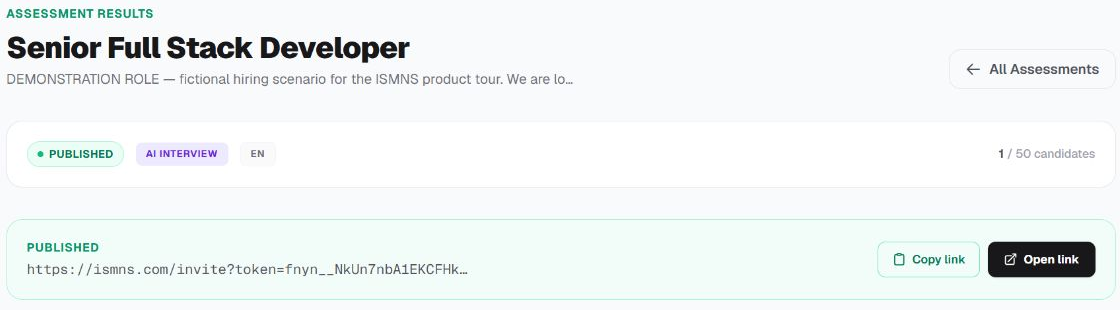
Envía el enlace a los candidatos
Comparte el enlace de tu evaluación. Los candidatos lo abren y empiezan sin crear una cuenta.
- Sin cuenta para los candidatos
- Compatible con móviles
- Un enlace por puesto
Evalúa las competencias en contexto
Los candidatos realizan una prueba de opción múltiple adaptada al puesto o una entrevista con IA que tiene en cuenta la descripción del puesto, su CV y sus respuestas.
- Prueba cronometrada con preguntas aleatorias
- La IA adapta sus preguntas a las respuestas del candidato
- CV y conversación de la entrevista disponibles
AI Interview
Recorded demo · 21 messages
- AI interviewer:
Hello Alex, thank you for joining the interview today. Let's dive right into our first topic. Can you describe a specific situation where you optimized a PostgreSQL query for performance? What was the issue, and how did you resolve it?
- Candidate:
In the fictional Demo Studio project, a tenant dashboard endpoint had a p95 latency of about 900 ms. I used query logs and EXPLAIN (ANALYZE, BUFFERS) on representative data to find an N+1 query pattern and repeated scans when filtering by tenant and date. I replaced per-row lookups with a single scoped query and added a composite index matching the filter and sort order. I checked tenant isolation and compared results before and after the change. In our synthetic example, p95 fell to 280 ms under the same workload. I also monitored write overhead and retained a rollback plan.
- AI interviewer:
Thanks for sharing that example, Alex. Let's move on to the next topic. Can you explain how you ensure API security when developing Node.js applications?
- Candidate:
I separate authentication from authorization. Each endpoint checks the authenticated user, their role and the tenant that owns the requested resource; a client-supplied tenant ID is never trusted on its own. I validate request schemas, use parameterized SQL and return only necessary fields. Secrets stay outside source code, tokens have short lifetimes, and cookies use secure settings where applicable. I add rate limits and safe error handling, and redact secrets from logs. In the demo project, integration tests include cross-tenant access attempts, expired sessions and malformed input. Dependency updates and security review are part of CI and release planning.
- AI interviewer:
Great, that provides a clear picture of your approach to API security. Now, let's discuss your experience with React and TypeScript. Could you describe a challenging feature you implemented using these technologies and the steps you took to overcome any difficulties?
- Candidate:
In the demo dashboard, I built a searchable table whose filters were shared with the URL. The difficult part was keeping fast typing, server requests and browser back navigation consistent. I used a typed filter model and runtime validation for URL values, kept draft input local, and debounced requests. I cancelled obsolete requests and ignored stale responses. I added keyboard navigation, explicit loading and empty states, and tests for back navigation and out-of-order responses. I chose simple components over a large state library because the state was confined to one feature.
- AI interviewer:
Thank you for that detailed explanation. Moving on, can you describe your approach to writing automated tests? How do you ensure they are effective and maintainable over time?
- Candidate:
I start from risks and observable behaviour. Unit tests cover deterministic business rules; integration tests exercise APIs with a real test database; a small set of Playwright journeys covers sign-in, tenant boundaries and critical workflows. I avoid coupling tests to component internals and use stable fixtures with explicit setup. When fixing a bug I add a regression case that fails for the original reason. CI runs fast checks on each change and slower suites separately. I investigate flaky tests instead of repeatedly rerunning them, and remove redundant tests when they no longer protect a meaningful behaviour.
- AI interviewer:
That's a solid approach to automated testing. Let's shift gears a bit. Could you tell me about a time when you had to mentor a junior developer? What strategies did you use to help them grow?
- Candidate:
In the fictional team, a junior developer struggled to diagnose intermittent API failures. We agreed on a small learning goal: turn an unclear bug report into a reproducible test. During pairing, I asked them to explain their hypothesis, inspect logs and narrow the input rather than taking over. We then wrote the regression test and a short debugging note together. In later reviews I separated blocking issues from suggestions and explained the reason behind each comment. We reduced pairing gradually as they became independent. I would assess progress through the problems they could solve and the questions they asked, not the number of lines written.
- AI interviewer:
Thank you for sharing that experience. Let's talk about performance optimization. Can you give an example of how you've improved the performance of a Node.js application? What specific techniques did you use?
- Candidate:
For a fictional CSV export feature, synchronous parsing and serialization caused event-loop delays that affected other requests. I measured event-loop lag, CPU usage and endpoint latency before changing the code. I moved long exports to a bounded background queue, streamed the output and applied backpressure instead of holding the whole dataset in memory. The API returned a job reference and the UI displayed progress. I capped concurrency to protect the database and tested failure recovery and duplicate requests. The trade-off was an asynchronous user flow, so we agreed on that behaviour with the product team. I would compare p95 latency, memory and error rates under the same load before claiming an improvement.
- AI interviewer:
That's a comprehensive approach to optimizing performance. Now, let's verify a specific claim from your CV. You mentioned working on integrating Jest tests and CI checks. Can you elaborate on how you set up these systems and how they benefited the development process?
- Candidate:
For the fictional Sample Works project, I configured Jest for fast TypeScript business-logic tests and a separate integration suite against an isolated PostgreSQL database. The CI pipeline installed locked dependencies, checked formatting and types, ran unit tests, then integration tests and a production build. Each test run used its own database state and secrets were injected by the CI environment. Pull requests could not merge if required checks failed. We added coverage for tenant boundaries and export retries after identifying risks, rather than chasing a coverage percentage. The benefit was earlier feedback and reproducible failures; I would track escaped regressions and flaky-test frequency to see whether it helped.
- AI interviewer:
Thank you for that detailed explanation. Now, let's explore a soft skill. How do you approach problem-solving when faced with a particularly challenging technical issue? Can you provide an example?
- Candidate:
I first describe the observed behaviour, impact and constraints, then list a few testable hypotheses. I reproduce the issue with the smallest useful case and change one variable at a time. In the fictional dashboard, users sometimes saw old search results after typing quickly. I used network timings to show that responses arrived out of order. I added request cancellation and a current-request guard, then a test that deliberately reversed response order. I shared a short explanation with the team and checked the fix with the designer. If evidence contradicts my hypothesis, I change direction; if I am stuck, I ask a colleague with a concise reproduction instead of hiding the delay.
- AI interviewer:
That's a thoughtful approach to problem-solving. Let's discuss collaboration. Can you share an example of how you've worked with a cross-functional team to deliver a project? What challenges did you face, and how did you overcome them?
- Candidate:
For the demo export feature, I worked with a designer, product manager and support colleague. The initial request was an instant download, but large datasets made that unreliable. I explained the constraint with measurements and proposed a background export with clear status and a retry option. We agreed on acceptance criteria for accessibility, completion time and failure messages, then released a small version behind a feature flag. Weekly demos exposed misunderstandings early. When scope grew, I made the delivery trade-offs explicit and let the product manager choose priorities. I documented the final decision and a rollback procedure for the team.
- AI interviewer:
Thank you for sharing that collaborative experience. Lastly, I'd like to discuss code reviews. How do you approach reviewing code from others to ensure quality and consistency?
- Candidate:
I first understand the intended behaviour and read the change in context. I check correctness, security boundaries, error handling, accessibility and meaningful tests before style. Automated formatting handles routine consistency so comments can focus on decisions. I label blocking issues and optional suggestions, explain the reason, and ask questions when I lack context. I keep reviews small and timely; for a complex design disagreement I propose a short discussion and record the outcome. In the demo team, a recurring checklist covered tenant isolation and database migrations. I also review my own assumptions and accept a simpler solution when it meets the requirements.
- AI interviewer:
Thank you, Alex, for all the detailed insights you've provided today. I appreciate you taking the time to discuss your experiences and skills with me. We'll be in touch soon regarding the next steps. Have a great day!
Fictional candidate · Preview only — no answers are sent
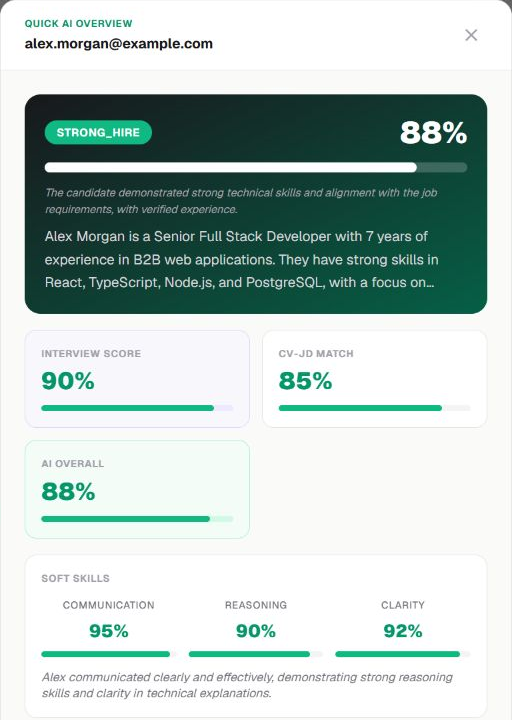
Identifica a quién entrevistar
Los candidatos reciben una puntuación y se clasifican al terminar. La vista rápida muestra la puntuación, las carencias y la recomendación.
- Clasificación en directo
- Fortalezas, carencias y adecuación del CV
- Una recomendación para orientar tu decisión
Contacta con los candidatos más adecuados
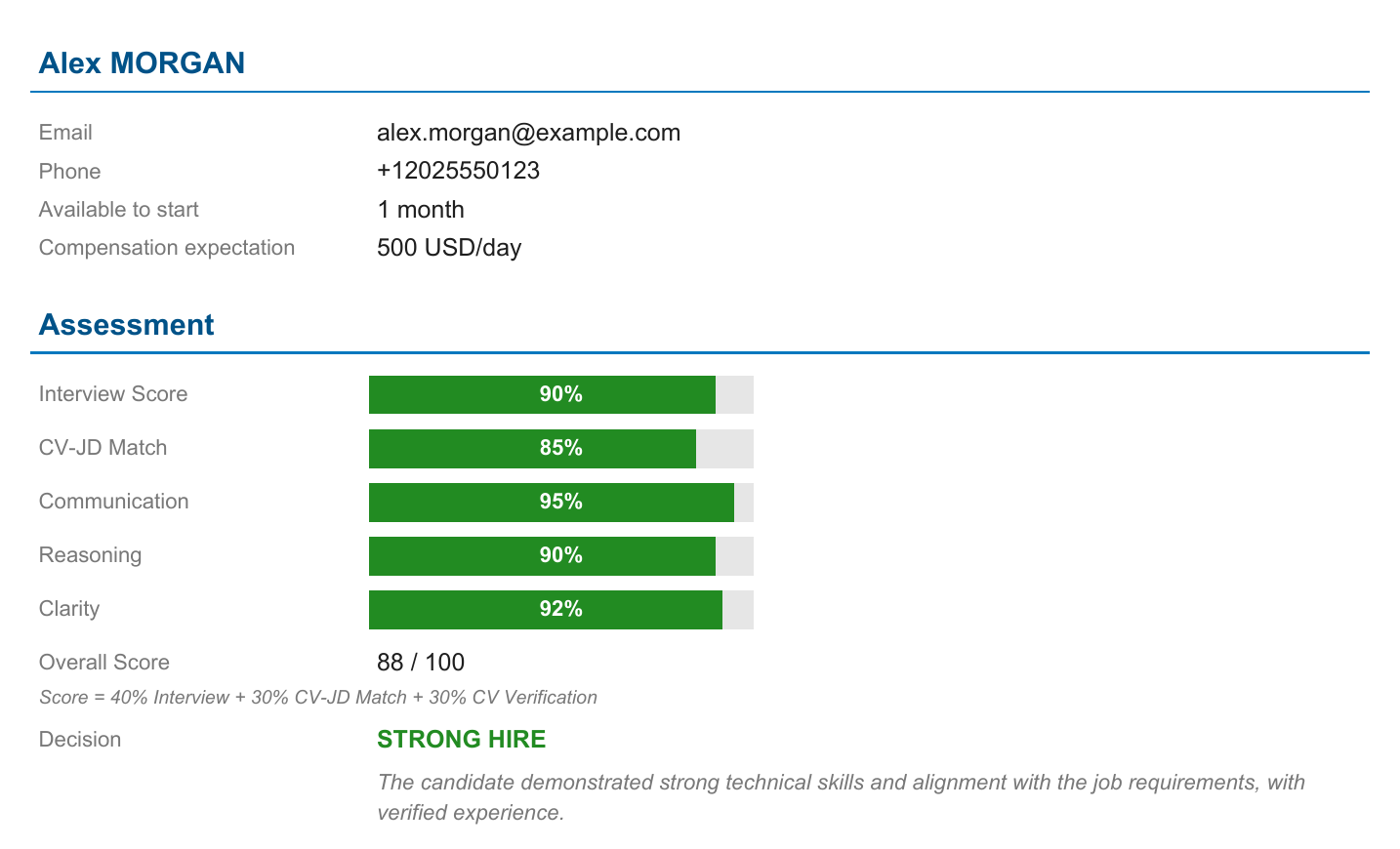
Consulta los resultados, el análisis del CV y los aspectos que conviene profundizar en un informe claro para elegir a qué candidatos contactar.
- Listo para compartir
- Listo para archivar
- El mismo formato para cada candidato
Por qué elegir ISMNS
La información para decidir. Antes de la primera llamada.
Cada evaluación se crea para tu puesto. Consulta las competencias evaluadas, el análisis del CV, la remuneración esperada y la disponibilidad de cada candidato. Decide a quién llamar con esa información.
Desde $1.79 por candidato. Menos que una llamada de preselección, y solo pagas por los candidatos que evalúas.
Competencias evaluadas
Una puntuación para cada competencia de tu oferta, basada en la evaluación.
CV analizado
Análisis según el puesto: fortalezas, carencias y experiencia relevante.
Remuneración y disponibilidad
Salario o tarifa diaria esperados y fecha de disponibilidad, recopilados antes de llamar.
Adecuación y recomendación
Habilidades interpersonales, recomendación y un PDF para compartir.
Dos modos de evaluación
Prueba de competencias o entrevista con IA: elige según el puesto
Una prueba para contrataciones de gran volumen. Una entrevista para perfiles sénior o de atención al cliente.
Prueba de competencias
Una prueba de opción múltiple cronometrada basada en tu oferta. Rápida de completar y corregir, con controles contra las trampas.
- Preguntas generadas a partir de la oferta
- Revisión y regeneración antes de publicar
- Tiempo limitado, orden aleatorio y detección de trampas
- Umbral de aprobación automático
- Puntuación por competencia
Ideal para
Puestos técnicos, gran volumen y preselección estandarizada
Entrevista con IA
Una conversación escrita adaptada al CV y las respuestas del candidato. Evalúa sus conocimientos y cómo los explica.
- Preguntas adaptadas en tiempo real
- Competencias técnicas e interpersonales
- Evaluación de la claridad y el razonamiento
- Detección de cambios de pestaña y pegado
Ideal para
Puestos sénior, atención al cliente y funciones donde la comunicación es clave
¿Tienes dudas? Una prueba para el volumen y una entrevista para los tres finalistas. El precio es el mismo.
Precios
Por candidato, menos que una llamada de preselección.
Un paquete por puesto, desde $39. Sin suscripción, sin licencias por usuario ni catálogo de pruebas. Reembolso en 7 días si nadie ha empezado.
Ideal para una primera contratación o preselección
- ✓Prueba de competencias o entrevista con IA
- ✓Evaluación adaptada al puesto
- ✓Informe PDF y análisis del CV
Para un puesto con muchas candidaturas
- ✓Prueba de competencias o entrevista con IA
- ✓Evaluación adaptada al puesto
- ✓Informe PDF y análisis del CV
Para preselecciones de gran volumen
- ✓Prueba de competencias o entrevista con IA
- ✓Evaluación adaptada al puesto
- ✓Informe PDF y análisis del CV
Contratación a gran escala y a medida
- ✓Prueba de competencias o entrevista con IA
- ✓Evaluación adaptada al puesto
- ✓Informe PDF y análisis del CV
Una evaluación por paquete: prueba de competencias o entrevista con IA. Análisis del CV e informes PDF incluidos. Ver precios detallados y condiciones de reembolso
FAQ
Preguntas frecuentes
Prueba de competencias o entrevista con IA: ¿qué diferencia hay?
La prueba es un cuestionario cronometrado de competencias técnicas. La entrevista con IA es una conversación escrita adaptada al CV y las respuestas, que también evalúa las habilidades interpersonales.
¿Qué contiene el informe PDF?
Puntuaciones por competencia, análisis del CV, fortalezas y carencias, disponibilidad, remuneración y recomendación. Los informes de entrevista añaden puntuaciones de comunicación, razonamiento y claridad.
¿Puedo cambiar las preguntas?
Sí. Revisa cada pregunta antes de publicar y regenera las que quieras cambiar.
¿Qué idiomas están disponibles?
Inglés, francés y español. Las pruebas y entrevistas se generan directamente en el idioma elegido.
¿Los candidatos necesitan una cuenta?
No. Abren el enlace, introducen su correo y comienzan desde cualquier dispositivo.
¿Están protegidos los datos de los candidatos?
Los datos se cifran en tránsito y en reposo. Solo puede acceder a ellos el reclutador que creó la evaluación.
¿Cómo funciona la entrevista con IA?
La IA analiza la oferta y el CV, y realiza una entrevista escrita en directo. Las preguntas de seguimiento se adaptan a cada respuesta.
¿Cómo funcionan los precios?
Un paquete por puesto, desde 39 $ por 15 candidatos. Sin suscripción ni cargos ocultos. Consulta los precios para conocer las condiciones de reembolso.
¿En qué se diferencia de los bancos de pruebas o las entrevistas en vídeo?
La evaluación se genera para tu puesto en minutos, sin catálogo de pruebas genéricas ni licencia por usuario. La entrevista es escrita y adaptativa: los candidatos no tienen que grabarse en vídeo.
¿Puedo probarlo antes de comprar?
Sí. Prueba un paquete gratuito para 3 candidatos, concedido una sola vez. Crea una prueba o una entrevista con IA y consulta los resultados e informes. Compra un paquete cuando necesites evaluar a más candidatos.
Tu primera entrevista, con el candidato adecuado.
Empieza con 3 candidatos gratis. Pega la descripción del puesto, comparte el enlace y consulta los resultados y el informe de cada candidato.